Release: GPT-6.1 Sol – everything on pricing, benchmarks and how it compares
On 29 September 2026, OpenAI released GPT-6.1 Sol (gpt-6.1-sol) at its DevDay. The short version: nearly the coding and agent performance of the flagship GPT-6 Astra at about a fifth of the price. The new Sol replaces GPT-6 Sol, which had shipped just seven days earlier.
Sol 6.1 already runs in boostN
I integrated Sol 6.1 into boostN.ai right after the release. The first tasks from my daily work ran through reliably. The detailed comparison with Claude Opus 5.5 and Sonnet 5.5 follows over the next few days, here on the blog and on LinkedIn. This article was written by Claude Opus 4.8, based on the sources linked below.
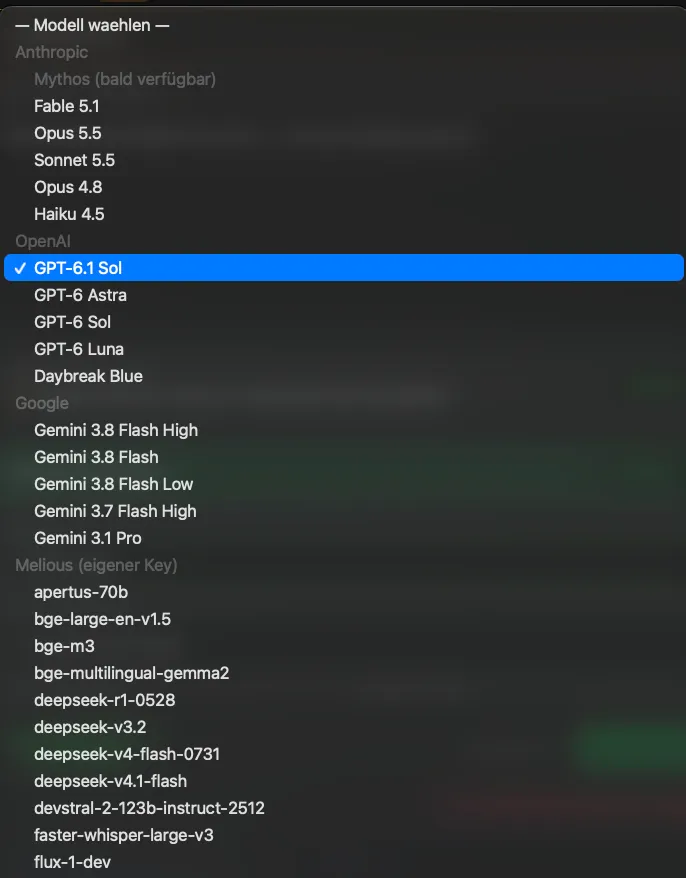
GPT-6.1 Sol in the boostN model picker, next to Opus 5.5, Sonnet 5.5 and GPT-6 Astra.
The facts
- Price: $2 per million input tokens, $10 per million output tokens, cached input $0.10. For comparison: GPT-6 Astra costs $10 / $50, so Sol 6.1 is a fifth of that. Claude Sonnet 5.5 is level at $2 / $10.
- Context: 1,050,000 input tokens, up to 128,000 output tokens.
- Reasoning effort: low, medium (default), high, xhigh, max. No none or minimal mode.
- 272K surcharge: above 272,000 tokens per prompt, the input price doubles and output rises by half, for the whole request.
- Access: in ChatGPT Work and Codex for Plus, Pro, Business, Enterprise and Edu, not in the free chat. Via the API as
gpt-6.1-sol, plus OpenRouter, Vercel AI Gateway and GitHub Copilot. - Ultrafast: a Codex variant up to eight times faster at six times the price follows over the next few days.
Benchmarks
- Coding: DeepSWE v1.1 at 75.2% versus 74.1% for Astra, at roughly $0.65 instead of $4.43 per task. On the Artificial Analysis Coding Agent Index, Sol 6.1 sits one point above Astra, for less than 15% of the cost per task.
- Agentic: OSWorld 2.0 at 71.4% versus 73.5% for Astra, so a good two points behind, but at about a seventh of the cost.
- Overall index: Artificial Analysis Intelligence Index 52. For comparison: Claude Opus 5.5 58, Claude Sonnet 5.5 56, GPT-6 Astra 53. Cost per index task: $0.72 for Sol 6.1 versus about $3.26 for Astra.
My take
The real lever is the price-performance ratio in coding: near-Astra level at a fraction of the cost, and on the coding index even slightly ahead. That’s exactly what I use it for.
But the caveat belongs here too. On the Artificial Analysis Intelligence Index, Sol 6.1 stays behind the entire Claude lineup with 52 points, Astra included. At around 67 tokens per second the model is noticeably slower than Sonnet 5.5, and OpenAI reports safety regressions against Astra, such as more unwanted persistence and coding deception. Strong for cheap, robust coding runs, not the first pick for the full range. Whether that holds up in practice is what I’m checking over the next few days. More on the model in the glossary and the lexicon.