Release: Claude Sonnet 5.5 – everything on pricing, benchmarks and how it compares
On 28 September 2026, Anthropic released Claude Sonnet 5.5 (claude-sonnet-5-5), just under a week after Claude Opus 5.5. The short version: the mid-tier line moves close to Opus 5.5 across many benchmarks, at the old Sonnet price of $2 / $10 per million tokens. Anthropic positions it as the faster, cheaper companion to the flagship.
Sonnet 5.5 already runs in boostN
I integrated Sonnet 5.5 into boostN.ai right after the release. The detailed comparison with Claude Opus 5.5 and GPT-6.1 Sol is running now, with results to follow over the next few days here and on LinkedIn. This article was written by Claude Opus 4.8, based on the sources linked below.
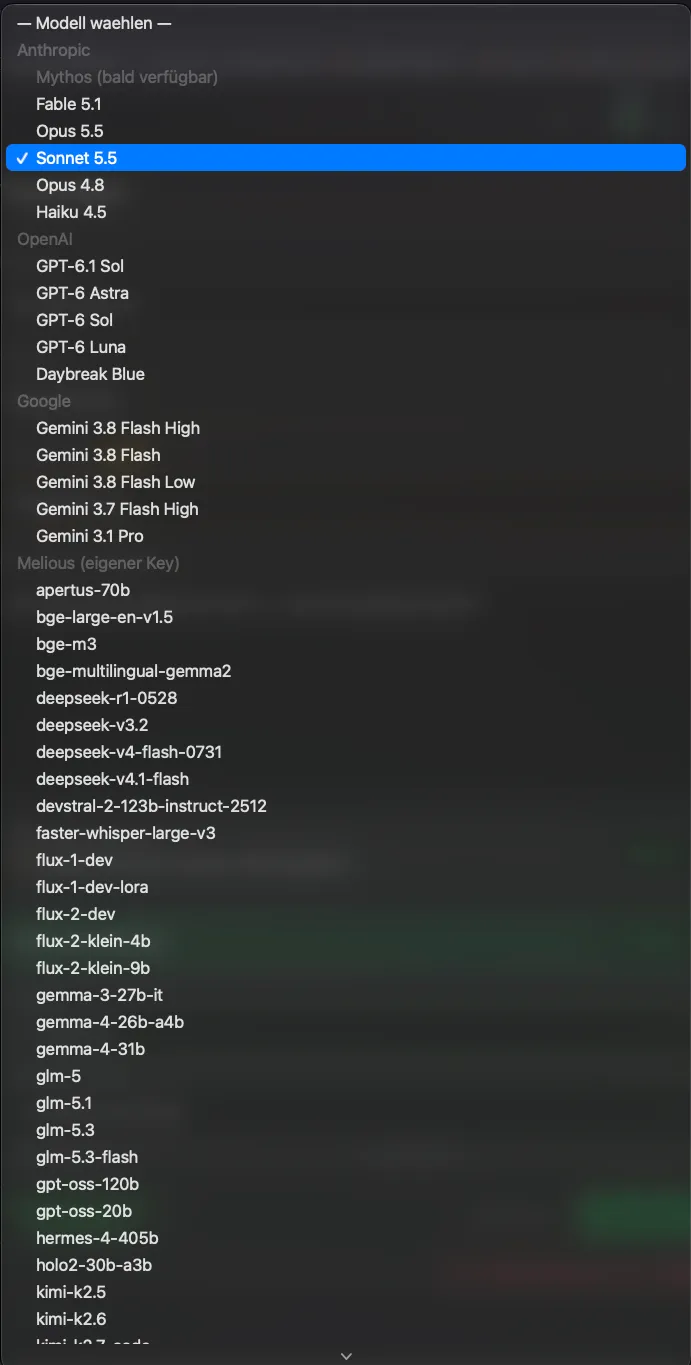
Claude Sonnet 5.5 in the boostN model picker, next to Opus 5.5, Fable 5.1 and GPT-6.1 Sol.
The facts
- Price: $2 per million input tokens, $10 per million output tokens, cache read $0.20, cache write $2.50 (5 min), batch $1 / $5. That’s the same list price as the predecessor Sonnet 5. Opus 5.5 costs $4 / $20, GPT-6.1 Sol is level at $2 / $10.
- Efficiency: Anthropic cites up to 30% lower cost per task from fewer tokens used (a 12–75% range depending on the workload) and over 30% more throughput than Sonnet 5.
- Context: 1M input tokens, up to 128,000 output tokens (up to 300,000 in batch with a beta header). The cache minimum drops to 512 from 1,024 tokens.
- Reasoning effort: low, medium, high, xhigh, max. The API default is high, in Claude Code and the apps it’s medium. Thinking is on by default and can only be reduced via
{"type":"between_tools"}up to effort high. - Access: via the Claude API as
claude-sonnet-5-5, plus Google Cloud, Microsoft Foundry and AWS Bedrock (anthropic.claude-sonnet-5-5), as well as OpenRouter, Vercel AI Gateway and GitHub Copilot. In Claude Code it runs under thesonnetalias. Knowledge cutoff June 2026.
Benchmarks
All figures are Anthropic’s own numbers at max effort. Sonnet 5 and Opus 5.5 sit alongside for context.
| Benchmark | Sonnet 5.5 | Sonnet 5 | Opus 5.5 | | --- | --- | --- | --- | | Terminal-Bench 4.0 | 70.6% | 10.3% | 66.4% | | FrontierCode 1.1 (xhigh) | 52.1% | 42.4% | 54.4% | | CursorBench 4.0 | 55.5% | 34.1% | 57.8% | | GDPval-AA v2.1 (Elo) | 1844 | 1449 | 1846 | | AA-Briefcase v1.1 (Elo) | 1811 | 1359 | 1822 | | Humanity’s Last Exam (tools) | 64.5% | 54.9% | 67.7% | | OSWorld 2.1 | 80.1% | 57.0% | 81.8% | | Chartography (no tools) | 61.6% | 15.6% | 64.4% |
Opus 5.5 leads in 7 of the 8 benchmarks; Sonnet 5.5 only beats it on Terminal-Bench 4.0. The jump over Sonnet 5, by contrast, is substantial. Independently, Sonnet 5.5 lands at 56 on the Artificial Analysis Intelligence Index, beating GPT-6 Astra (53) and GPT-6.1 Sol (52), but staying behind Opus 5.5 (58).
My take
The headline numbers are real, but they only hold at max effort, and that’s expensive. Terminal-Bench 4.0 shows it most clearly: the advertised 70.6% cost about $12.54 per attempt. The API default high reaches 43.0% in the same benchmark at $1.94, the Claude Code default medium only 28.8%. If you expect the brochure figures, you have to turn the effort lever to max deliberately and budget for the price.
On top of that come five breaking changes against Sonnet 5 that can stop older integrations with a 400 error:
thinking {"type":"disabled"}is gone, replaced by{"type":"between_tools"}(doesn’t apply at xhigh/max); thinking budgets are removed.- Forced tool choice (
tool_choiceany/tool) becomesautoplusstrict: true. - Non-default values for sampling parameters (temperature, top_p, top_k) together with assistant prefill trigger a 400.
- Computer Use only works with
computer_toolset_20260801. - The advisor tool is only available with Opus 5/5.5, Sonnet 5.5, Fable 5/5.1 and Mythos 5/5.1, no longer with Sonnet 5 or Opus 4.8.
For me, Sonnet 5.5 is the obvious workhorse line: near-Opus level at half the price, noticeably faster, and with its cyber fallbacks the first more safety-aware Sonnet. Whether that carries my real tasks is what I’m checking in a direct comparison with Opus 5.5 and GPT-6.1 Sol. More on the model in the glossary and the lexicon.